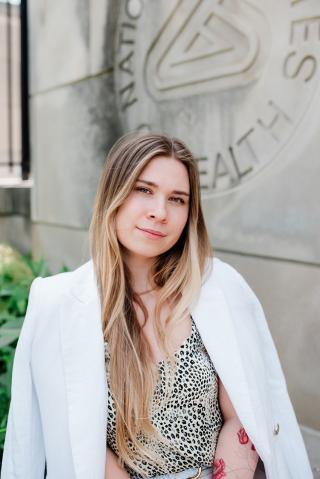
Anhelina Bilokon, AuD and PhD Candidate, has been awarded a post-doctoral fellowship award to study how sex as a biological variable impacts auditory processing.
"The goal of the NIDCD Research Dissertation Fellowship for Au.D. Audiologists (F32) program is to support comprehensive and rigorous biomedical research training leading to a research doctorate (i.e., Ph.D.) in the biomedical, behavioral, or clinical sciences." - NIDCD
Not Just Noise: Hormonal Variability in Auditory Processing
Sex differences are becoming an increasingly important variable in hearing research and are often treated as a simple comparison between males and females or as another source of variability in the data. Sex differences are not binary or static, and biological factors, such as endogenous hormones, that vary within an individual may influence auditory function. Estrogen is suggested to mediate sex-related differences in auditory processing. However, we do not yet understand how estrogen may mediate sex-related differences in temporal processing. We hypothesized that temporal processing would vary across low-estrogen (LE) and high-estrogen (HE) phases of the female menstrual cycle, with greater differences compared to males emerging during the HE phase. Premenopausal healthy females and age-matched males participated in behavioral temporal processing measures using gap-detection thresholds. Female participants were tested across LE and HE phases, with males included as a comparison group. Overall, temporal processing varied by biological group and stimulus type, with poorer performance observed during the HE phase and greater difficulty for speech-shaped noise than broadband noise. These preliminary findings suggest that hormones may provide important information about why auditory performance differs between and within individuals over time. This may also be clinically relevant as temporal processing is particularly important in complex listening environments and is not always captured by standard measures of hearing sensitivity. Therefore, considering hormonal variability may provide a more sensitive approach for understanding individual differences in hearing and, ultimately, how we interpret both behavioral and clinical auditory measures.
Anhelina Bilokon is a PhD candidate at the University of Maryland and holds a Clinical Doctorate in Audiology. Her research focuses on the interaction of sex as a biological variable and age on binaural hearing and temporal processing in acoustic and cochlear implants. She is trained in rare genetic disorders and specialized audiometric/vestibular care at the National Institutes of Health/NIDCD.
Anhelina co-authors publications and presents her research at conferences such as the American Auditory Society and the Acoustic Society of America. She served as President of the Student Academy of Audiology and the Non-Traditional Student Society.
She mentors undergraduate and graduate students and has extensive experience in audiometric and vestibular assessments, bridging her clinical expertise with research in audiology.