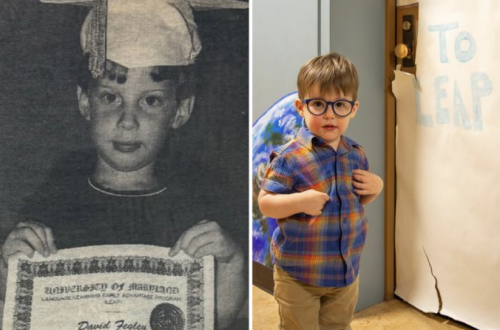
Two generations of the Fegley family have now benefitted from enrolling in the Language-Learning Early Advantage Program
When Hannah Fegley’s son—Adrien, 2—was 12 months old, she noticed that his speech and language development were delayed. The family began working with the Montgomery County Infants and Toddlers Program, but they eventually made the decision to explore other options, believing that Adrien would benefit from a more intensive speech therapy program.
Hannah knew just who to reach out to: The Language-Learning Early Advantage Program (LEAP) Preschool located within the University of Maryland’s Department of Hearing and Speech Sciences’ (HESP) Hearing and Speech Clinic.
Hannah already knew about LEAP because her younger brother, David, was a part of LEAP’s first graduating class.
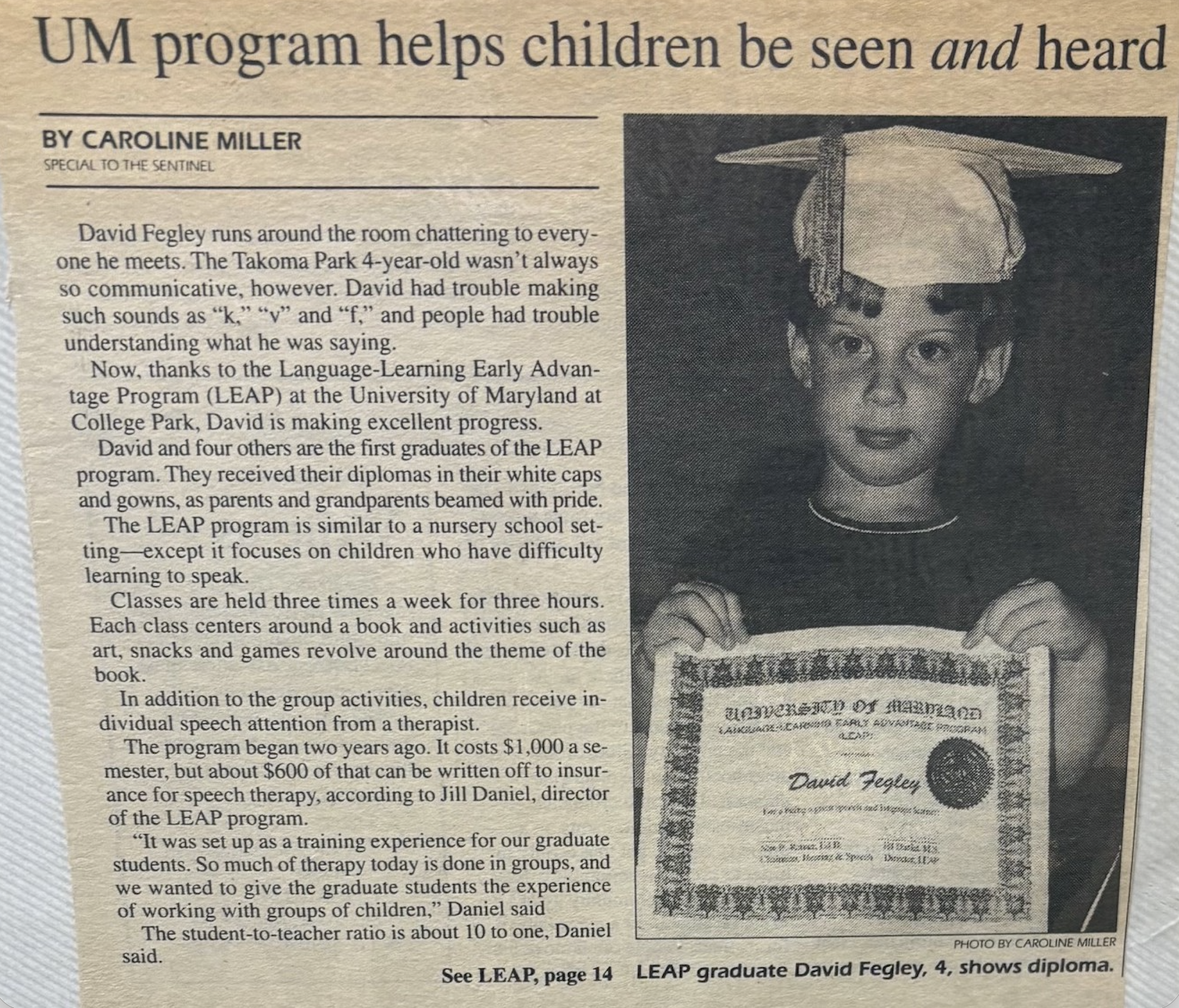
“He was unintelligible; he talked a lot, but no one could understand him,” Hannah recalled with a laugh. “LEAP made a big difference for my brother, and it was hugely helpful for our family.”
David—who is now a lawyer, and married to an elementary school teacher who is herself a Terp alumna—went to LEAP to work on challenges he was having with pronunciation.
Adrien has been working with LEAP toward different speech and language goals, including understanding prepositions, producing two-word utterances, and accurately saying vowel-consonant words.
Hannah says that Adrien “adores” the time he gets to spend one-on-one with his speech therapist, Casey Strauss, a 2027 Speech-Language Pathology master’s degree candidate in HESP.
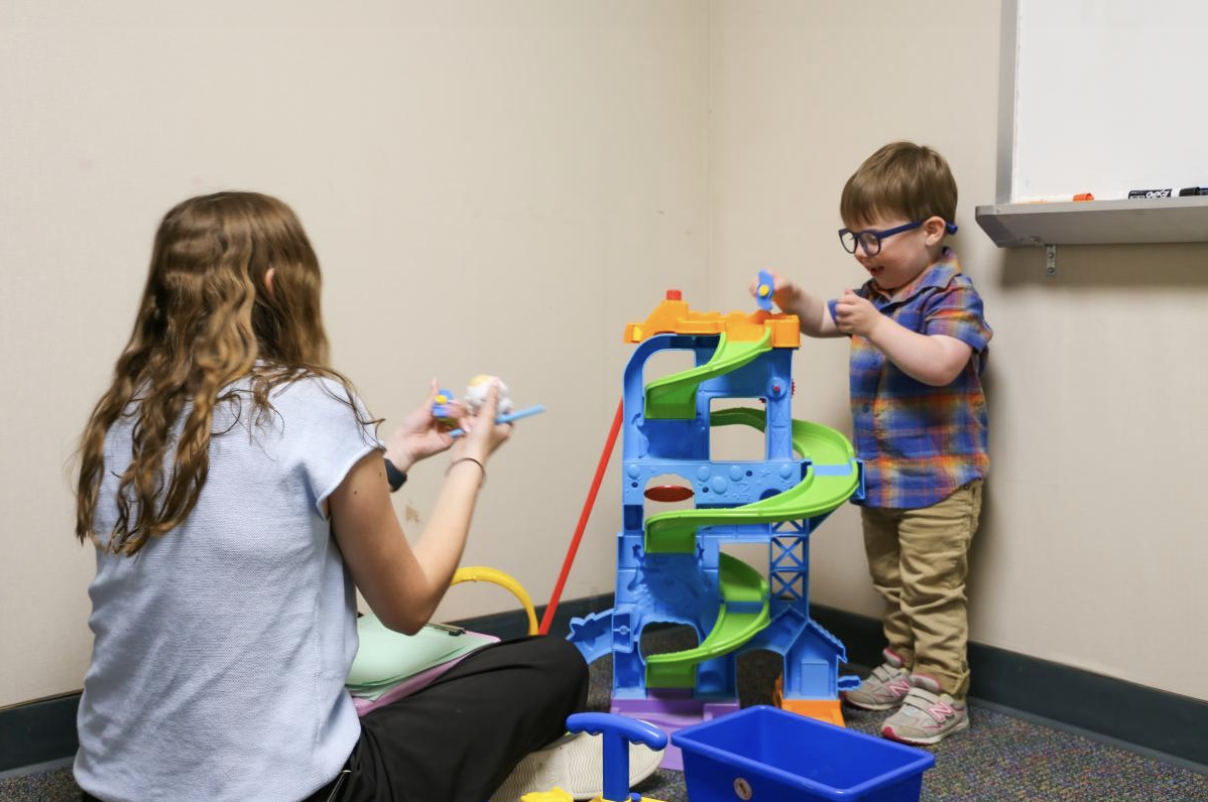
“We target all of Adrien’s goals through child-led play,” Strauss said. “As we play, I model relevant phrases using two words, and we practice correctly articulating the sounds in many of the prepositions. He has been making excellent progress towards his goals, and he is so fun to work with. He brings everyone so much joy with his smiles and excitement.”
Despite Adrien only having been with LEAP for roughly two months so far, Hannah can already see its positive impact.
“There are way more attempts to communicate verbally than there was before, Adrien’s speaking way more clearly, and his vocabulary is increasing. When he first came to LEAP, he was primarily just using one word at a time to communicate, occasionally two. Now he’s frequently speaking and putting two or even three words together, and you can see him really trying to get his mouth and tongue in the right place to make certain sounds,” she said. “In a short time, we have seen a huge difference.”
Adrien’s experience with LEAP takes his grandmother, Stacey Katz, back to when David was a LEAP student.
“When I joined my daughter in the observation room watching Adrien learn how to say new words, I cried. It brought me back over 30 years ago to when David was in that very same room learning sounds he had never developed as a toddler,” Katz recalled. “I know Adrien will be fine, thanks to LEAP. Not only did his uncle learn to pronounce words, but he grew up to be an outstanding public speaker and communicator.
“One-on-one speech therapy, three times per week within a nursery school setting, staffed by such expert and enthusiastic graduate students is the best model I can imagine and we are so lucky it is right here in College Park,” she added. “I have such immense gratitude for the LEAP program and its lifelong impact on our family.”
The Fegley family is so grateful for LEAP, Hannah, her father and Adrien attended a public meeting before the Council on Academic Accreditation reviewers—who were deciding on whether to recertify HESP’s clinical audiology and speech-language pathology graduate programs—to share about the program’s positive impact earlier this year.
Adrien’s favorite part of the day was enjoying the South Campus Dining Hall’s warm chocolate chip cookies afterward.

“Knowing that LEAP is supporting multiple generations is a powerful reminder that this work extends far beyond the classroom. It lives on in families and in the lasting impact of being seen and supported,” said Courtney Overton, LEAP director and an assistant clinical professor in HESP.
This post is originally from the BSOS website.